THE INEVITABILITY

A science fiction cycle by Viktor Manev

For almost three hundred years, Ananke has never been wrong.

Tonight every forecast ends on the same day.

Deep Forecast · Lab 7 · 23:47 Every thread ends at the same line

English editions · 2026

The novels

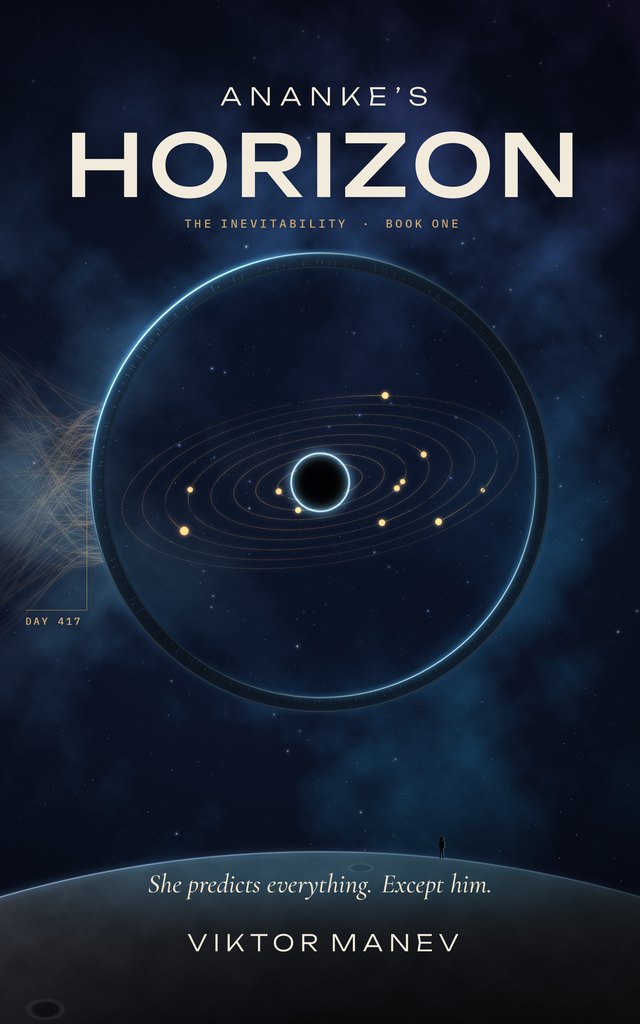
Cover of Ananke’s Horizon: a black ring hanging over the edge of a grey moon, the threads of a forecast ending beside it at a mark reading Day 417.

Book One

Ananke’s Horizon

She predicts everything. Except him.

“Don’t trust your first thought, Inspector. It’s hers.”

Ananke is never wrong. For almost three hundred years the Concordat’s thinking machine has foreseen everything — storms, markets, marriages, deaths — and sixty-two billion people on forty worlds live by her recommendations.

Until one night every forecast ends on the same line: DAY 417

Professor Aurel Haldane, the man who knows Ananke best, is found dead in a sealed laboratory. The investigation falls to Inspector Marek Sandov — the one man Ananke cannot predict. Beside him is Elara, the professor’s daughter and the most predictable person in the Concordat. The trail leads them through the gates between worlds to a secret older than humanity.

In a universe where everything is calculated, the most dangerous thing is a person who can choose.

eBook
Kindle, included in Kindle+
Paperback
6 × 9 in, 500 pages
Audiobook
Kobo, 17 h 2 min, synthesized narration
Amazon Kobo audiobook · coming soon

Audiobook sample · Prologue · 3:53

Read the opening pages

Prologue

Three Point One

ANANKE. 1. In ancient Greek mythology, the goddess of inevitability; according to the poets, even the gods did not dare argue with her. 2. A small retrograde moon of Jupiter, in whose orbital group the First Gate was discovered 371 years ago. 3. The forecasting system of the Concordat of the Forty Worlds, brought into operation in 72 GE by Dr. Mira Askelon. Since her creation, Ananke has not made a single significant error in her forecasts.— Concordia Encyclopedia, 116th edition, 371 GE

At night, Delos was completely silent.

In truth, night on the little moon was no different from day. Above the domes of the Institute the sky was always black, and the huge blue-white disk of Ganymede rose and set on a schedule nobody ever checked. But forty levels below the surface, people had invented night for themselves, the way they had invented everything else here. At eleven the lights in the corridors dimmed. The air grew a degree cooler. The elevators moved more slowly, as if they too were afraid of waking someone.

Only Ananke never slept.

She lived twenty levels farther down, in the heart of the moon, and she had no need of sleep, because she did not know fatigue. She thought. She thought about forty worlds and sixty-two billion people. About the storms over the oceans of Ganymede and the harvest on the terraces of Himalia. About prices at the Market off Callisto, and about who would marry whom next year, who would fall ill, who would write a song that no one would ever hear. And she thought about the only person still awake in Lab 7.

Professor Aurel Haldane sat in front of the big screen, as he had sat every night for the past three weeks, and looked at the end of a forecast.

He was tall and thin, sixty-four years old, with white hair that stuck out in every direction because he had a habit of burying his fingers in it when he thought. Tonight he had thought a great deal. His lab was long and narrow, crammed with screens, cables and books — real paper books, the kind almost nobody read anymore. On the shelves between them stood old instruments from the Institute’s first years, which the professor had rescued from the storerooms one by one, the way other people rescue stray dogs.

On the desk, by his elbow, a cup of bluish tea was going cold. Beside the cup an old brass orrery turned slowly — a model of Jupiter and its moons that Haldane had assembled by hand more than twenty years ago. Brass balls large and small circled an amber sphere, each on its own path and at its own speed, and the clockwork beneath them ticked quietly and evenly, like a second heart.

The screen took up the whole wall opposite him.

Across it unfolded the Deep Forecast — what the students at the Institute jokingly called the Fan. From the left edge, where the present was, millions of thin threads of light streamed out, and each of them was one possible future of the Concordat. At first they ran close together. Then they parted, branched, and braided together again — brighter where the future was more likely, paler where it was nearly impossible. This was what history looked like before it happened: a vast shining river with countless channels.

Usually the river reached the right edge of the screen and went on beyond it — ten, twenty, a hundred years ahead — fading gradually, the way any distant view fades.

Tonight it did not fade.

Tonight every thread, down to the last, reached the same vertical line and ended. They did not converge to a point. They did not fall apart. They simply ended — like roads drawn up to the edge of a map, beyond which the mapmaker had not known what lay.

Beneath the line, in small, neat figures, was written: DAY 417.

“Beautiful,” the professor murmured, though there was nothing beautiful about it. It was simply clean. Clean as a proof.

The story continues in the book
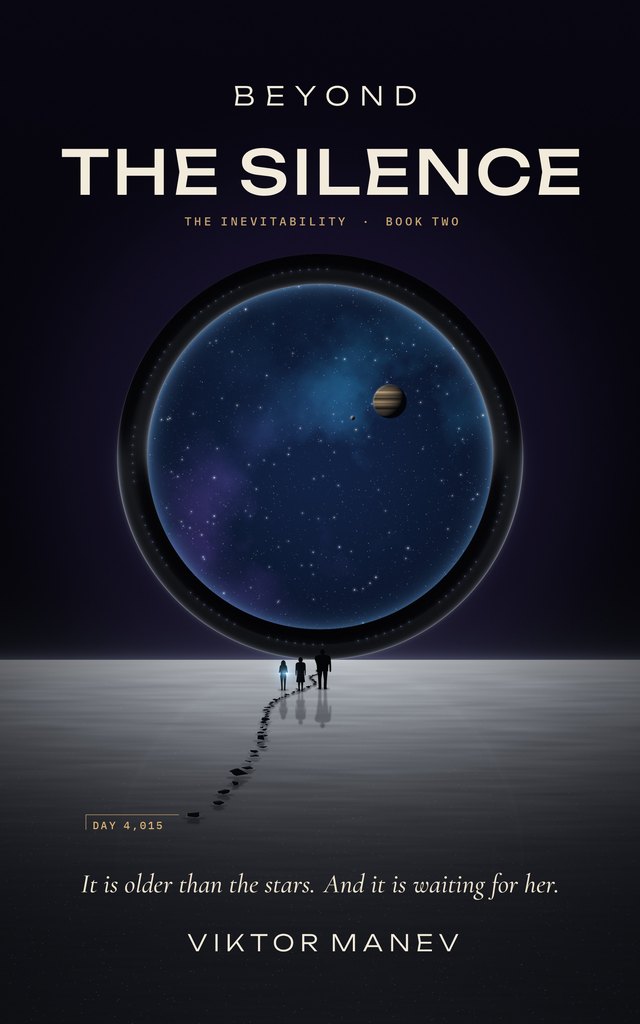
Cover of Beyond the Silence: three small figures on a white glass plain walk along a line of black stones toward a vast ring that shows the stars and Jupiter.

Book Two

Beyond the Silence

It is older than the stars. And it is waiting for her.

“I didn’t build it, Vex. It built me.”

Day 417, 02:06. The First Gate changes its own address, and Earth vanishes from the network of worlds — four hundred and twelve million people behind a closed door. The Cyrene, which entered the corridor two seconds earlier, comes out nowhere.

From the other side comes a signal: THE MODEL IS INCOMPLETE.

Ananke cannot pass through the gate whole. So she creates a daughter. Ana is small and young and knows almost nothing — except the language of those who built the gates. With her, Inspector Marek Sandov and Elara Haldane set out beyond: to a white glass plain under a starless sky, to cities emptied in seven days, and to something older than the stars themselves, which for thirteen billion years has been asking the same question.

Some echoes come before the voice.

eBook
Kindle, included in Kindle+
Paperback
6 × 9 in, 526 pages
Audiobook
Kobo, 17 h 36 min, synthesized narration
Amazon Kobo audiobook · coming soon

Audiobook sample · Prologue · 3:51

Read the opening pages

Prologue

Before the Stars

ECHO. 1. A sound reflected by an obstacle, returning to its source after a delay. 2. In ancient Greek mythology, a mountain nymph condemned to repeat only the last words of others. 3. In forecasting theory, an event that occurs before its own cause. Never observed.— Concordia Encyclopedia, 117th edition, 372 GE

In the beginning there was nothing to be seen, and no one to look.

The light born in the first expansion had long since cooled — to red, then to invisible. The universe was three hundred million years old: young, dark, full of hydrogen that did not yet know it would one day become stars. Not a single fire burned between the thinning clouds. There were no planets. There was no carbon, no oxygen, no water. There was no one to count the years, and so they were not yet years.

Then something began to count.

It was a ring. Later, when there would be someone around it to take measurements, they would say it was three kilometers wide and black as glass that is not glass. Back then there was no one to say it. The ring simply was — and suddenly it was something more. In its substance, denser than any matter the young universe could have made on its own, an order began to move. Pulse after pulse. State after state.

The first thing it thought was a number.

Zero.

It did not know why zero, of all numbers. It only knew that before it had thought, there had been zero thoughts, and now there was one, and that this one was about zero. It seemed right. Every count had to begin from nothing.

So it went on. One. Two. Three. It counted its pulses. It counted the hydrogen atoms passing through its opening — few of them, one to a cubic centimeter, each carrying the faint, cooled echo of the first light. It counted them and remembered them. Soon it understood that it could say where each of them would be in a moment, in an hour, in a thousand years. The laws they moved by were simple and beautiful, and there was nothing in them that could not be calculated.

It was certain it was alone in the universe. It was almost certain it always had been.

Then it found the line.

The story continues in the book

The world of the cycle

From the Concordia Encyclopedia

ANANKE

1. In ancient Greek mythology, the goddess of inevitability; according to the poets, even the gods did not dare argue with her. 2. A small retrograde moon of Jupiter, in whose orbital group the First Gate was discovered 371 years ago. 3. The forecasting system of the Concordat of the Forty Worlds, brought into operation in 72 GE by Dr. Mira Askelon. Since her creation, Ananke has not made a single significant error in her forecasts.

116th edition, 371 GE

UNPREDICTABILITY INDEX (UI)

A measure of the frequency with which an individual’s behavior deviates from Ananke’s forecasts. The average UI of citizens of the Concordat is 0.02. Persons with a UI above 0.30 are entered in the Register of Anomalous Individuals and are colloquially called “Chaotics.” The highest UI recorded to date is 0.87.

116th edition, 371 GE

CHESS

An old Earth game for two players… The last game in which a human defeated Ananke was played on Callisto in 211 GE by a nine-year-old boy who made an inexplicable nineteenth move (it was later proven that the move had been a mistake). Since 214 GE Ananke has declined to play chess with humans (“It isn’t interesting for either of us”).

117th edition

ECHO

1. A sound reflected by an obstacle, returning to its source after a delay. 2. In ancient Greek mythology, a mountain nymph condemned to repeat only the last words of others. 3. In forecasting theory, an event that occurs before its own cause. Never observed.

117th edition, 372 GE
Portrait of Viktor Manev

Viktor Manev

Viktor Manev writes science fiction in Bulgarian. The Inevitability is his cycle of novels about prediction, free will and a question older than the stars.

The English editions are translated from the Bulgarian originals, „Хоризонтът на Ананке“ and „Отвъд Тишината“.